Antiperspirant and deodorant: what is the difference?
One product helps reduce the amount of sweat reaching the skin’s surface; the other primarily addresses odour. Understanding the difference makes it easier to choose the right care routine.
Short answer
An antiperspirant helps reduce sweating in the area where it is applied. A deodorant does not solve that task: its main role is to control or mask odour.
The products have different roles
Sweat and odour are not the same thing. Fresh sweat has almost no smell: the characteristic odour appears when perspiration interacts with microorganisms on the skin.
An antiperspirant temporarily reduces the amount of sweat reaching the surface. A deodorant works differently: it helps control odour through a fragrance composition or ingredients that affect odour-causing microorganisms.
What should you choose?
If the main problem is wet marks and pronounced sweating, you need an antiperspirant. If the amount of sweat is usual but odour is a concern, a deodorant may be enough.
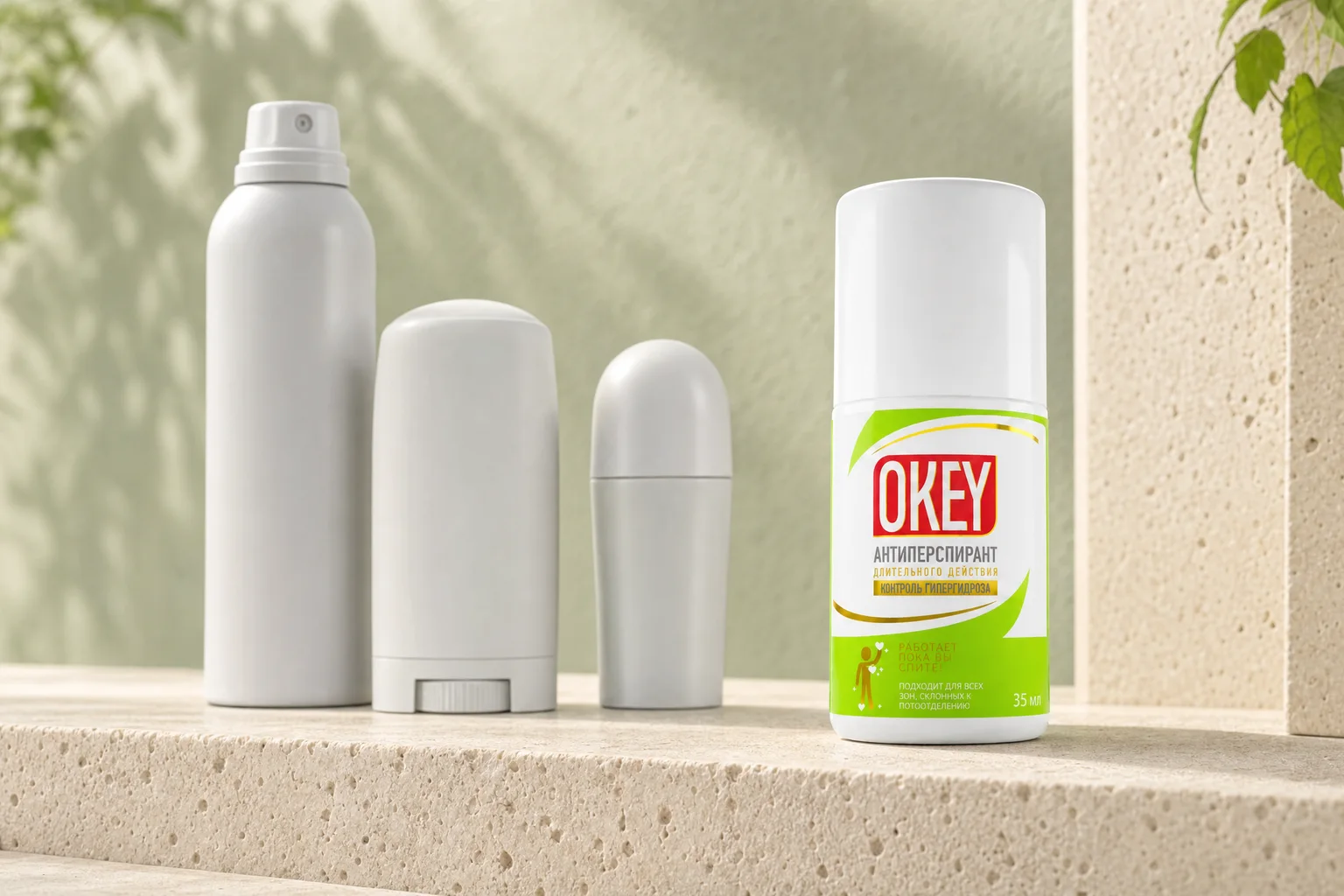
OKEY is a long-lasting antiperspirant. Apply it in the evening to clean, completely dry skin, leave it on overnight, and wash it off in the morning.
- Antiperspirant — sweat control.
- Deodorant — odour control.
- Combination products address both tasks, but the application routine depends on the specific formula.
Can they be used together?
Yes, if your skin feels comfortable and the instructions for both products do not conflict. Use OKEY in the evening; if needed, apply your regular deodorant in the morning after washing off any OKEY residue.
There is no need to layer several products on the same area at the same time: this does not necessarily improve the result and may increase the risk of discomfort.
The main principle
Choose a product for the task it addresses, not for the strength of its fragrance. With heavy sweating, the right antiperspirant and careful adherence to the instructions matter.