Sweating and the thyroid: when to check your hormones
You feel hot where you used to be comfortable, and the sweating has arrived together with a pounding heart and irritability, so the thought comes up: could it be my thyroid? Here is when that question is really worth asking a doctor and how sweating with thyroid disease differs from ordinary heavy sweating of the underarms or palms.

Short answer
An overactive thyroid (hyperthyroidism) speeds up the metabolism, and the NHS lists warm skin, excessive sweating and sensitivity to heat among its common signs, usually together with other symptoms: nervousness, a fast heartbeat, shaky hands, poor sleep. It is checked with a blood test for hormones. If, on the other hand, specifically your underarms, palms or feet have sweated since childhood or adolescence and you do not sweat at night, that looks more like primary hyperhidrosis than a thyroid problem.
How the thyroid is linked to sweat
Thyroid hormones set the pace of the metabolism. When there is too much of them, which is called hyperthyroidism or thyrotoxicosis, the body produces more heat. The American Thyroid Association (ATA) lists increased sweating and feeling hot among the symptoms, and the NHS lists warm skin, excessive sweating and sensitivity to heat.
An interesting detail: the International Hyperhidrosis Society (IHHS) cites data showing that the sweating rate did not increase significantly in thyrotoxicosis in a study. In other words, sweat here is part of a general picture of overheating rather than a separate sign that points to a thyroid problem on its own.
Which signs to discuss with a doctor
Sweating on its own says almost nothing about the thyroid. It is the combination that should make you take notice. The NHS and the ATA list these among the common signs of hyperthyroidism:
- nervousness, anxiety, irritability, mood swings;
- a fast or irregular heartbeat, shaky hands;
- difficulty sleeping while feeling tired all the time, muscle weakness;
- sensitivity to heat, warm moist skin;
- thirst, needing to pee more often, diarrhoea, itchiness.
And if the thyroid is underactive
With an underactive thyroid (hypothyroidism) the picture is the opposite: the NHS lists feeling cold more than usual and dry skin and hair among the common symptoms. Excessive sweating is not on that list. So if you sweat a lot and feel cold at the same time, a lack of thyroid hormones is not the place to look for the cause.
How this differs from hyperhidrosis
The IHHS distinguishes two types of heavy sweating. Primary hyperhidrosis usually begins in childhood or adolescence, affects specific areas such as the underarms, palms, feet or face equally on both sides and usually does not happen during sleep. Secondary hyperhidrosis results from another condition or a medicine: it more often starts in adulthood, covers larger areas of the body and often happens at night.
Thyroid disease is one of the secondary causes. If the sweating started recently, all over the body and together with the signs listed above, see a doctor. When else to see a specialist is covered in “What is hyperhidrosis, and when should you see a doctor?” and “Night sweats: when they are normal and when to see a doctor”.
How it is checked
According to the NHS, a simple blood test can often show whether symptoms are caused by a thyroid problem. The ATA adds that in hyperthyroidism, test results usually show high T4 and/or T3 and low TSH. The doctor may then order an examination and an ultrasound if needed.
Do not start any “thyroid” remedies on your own. Treatment is chosen by an endocrinologist: according to the ATA, some medicines control a fast heartbeat and shakiness until hormone levels improve, and hyperthyroidism caused by thyroiditis often goes away on its own within a few weeks or months.
Bottom line: the cause first, then the product
If sweating is part of a new picture with a pounding heart, feeling hot and nervousness, get tested first: an antiperspirant does not treat the thyroid and should not delay a visit to the doctor. If your hormones are fine and specific areas sweat heavily, that is a job for an antiperspirant.
OKEY works precisely on local sweating: the underarms, palms, feet and other areas. You can also use it while you are being examined, so that sweat bothers you less on ordinary days.
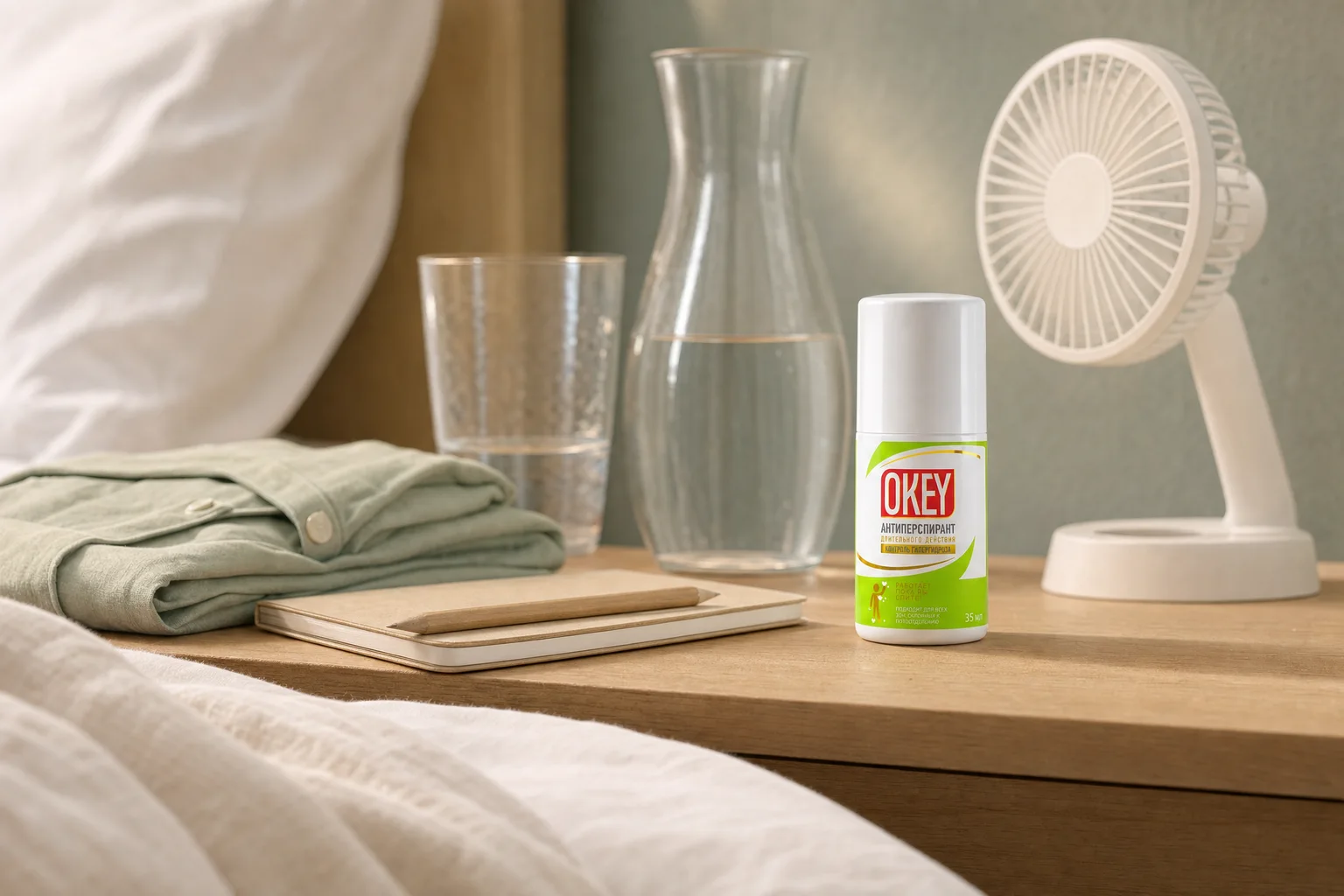
OKEY is a long-lasting, fragrance-free antiperspirant for women and men in a 35 ml roll-on bottle. It suits all areas prone to excessive sweating. According to the instructions, it is applied in the evening before bed in a thin layer to clean, completely dry and intact skin, and any residue is washed off in the morning. OKEY is available on Kaspi for 7990 ₸ with a 14-day bottle return. Regular customers can buy it on our website okeystaydry.com for 6990 ₸ with free delivery to a Flip pickup point, without a return option. The buy button is below.
Sources and documents
- NHS: symptoms of an overactive thyroid (hyperthyroidism)
- NHS: symptoms of an underactive thyroid (hypothyroidism)
- American Thyroid Association: hyperthyroidism
- International Hyperhidrosis Society: generalised secondary hyperhidrosis
- International Hyperhidrosis Society: two types of hyperhidrosis
- Full OKEY instructions