When sweating makes you feel embarrassed: how to get your calm back
Not raising your arms in photos. Wearing only black. Turning down handshakes, dates and bus rides. If you recognise yourself, you are not alone and there is nothing wrong with you: embarrassment about sweat is a common and understandable reaction. This article is not about how to “stop worrying”, but about how to get your choices back.
Short answer
Embarrassment about sweating is common: in a study by Bahar and colleagues (JAAD, 2016), anxiety and depression were about three times as common in people with hyperhidrosis as in other dermatology patients. Anxiety itself increases sweating, which creates a vicious cycle. Practical steps help, such as preparing the night before, choosing clothes and having a plan for awkward moments, and so does treatment if sweating is heavy. The NHS advises seeing a GP if odour or sweat affects your self-esteem, and if fear of sweating makes you avoid people, talking about social anxiety: the best treatment for it is cognitive behavioural therapy.
You are not alone
The International Hyperhidrosis Society (IHHS) describes how people with heavy sweating often feel embarrassment, shame and social anxiety because of sweat-soaked or stained clothing. Many avoid shared offices, parties, restaurants and public transport, do not shake hands and hide sweat under dark clothes and extra layers.
This is not oversensitivity. In a study by Bahar and colleagues (JAAD, 2016) of more than two thousand dermatology patients in Canada and China, anxiety was found in 21.3% of people with hyperhidrosis versus 7.5% without it, and depression in 27.2% versus 9.7%. The heavier the sweating, the more common anxiety and depression were.
Why embarrassment makes sweating worse
The IHHS calls it a vicious cycle: worry about how sweating looks to others itself becomes a signal to the sweat glands. You fear sweating, sweat more out of fear, notice it and become even more afraid. More on how nerves trigger sweating in “Sweating when nervous: why the body reacts to stress”.
The cycle can be broken from two sides: reducing the sweat itself and reducing the fear of it. Working on both is best.
What helps in the moment
A plan made in advance lowers anxiety more than trying “not to think about sweat”:
- keep a spare t-shirt, tissues and a small towel in your bag;
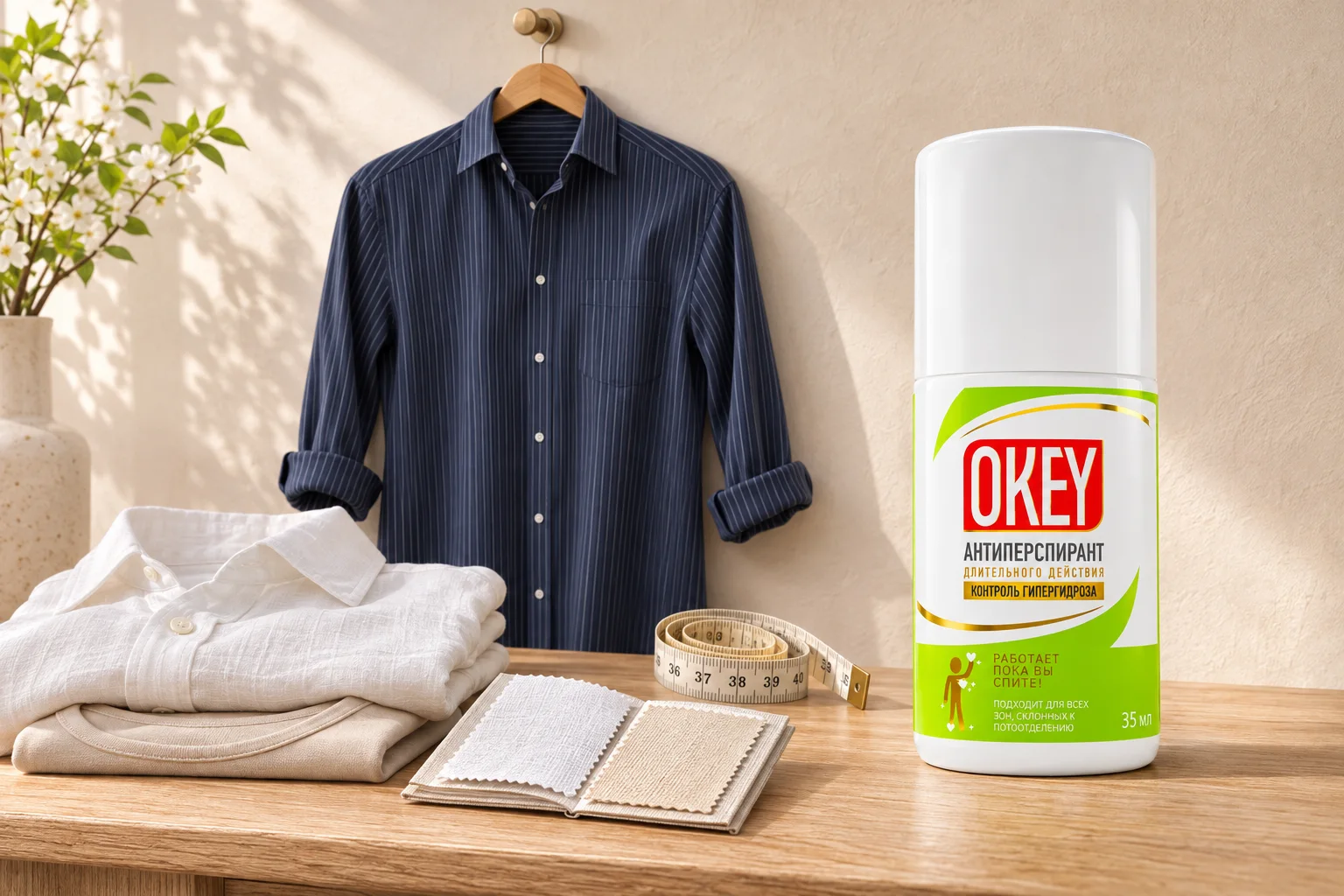
- choose patterns and light, breathable fabrics: dark colours are not the only option, more in “Fabrics for heavy sweating”;
- have a simple line ready, such as “I'm a bit hot, back in a minute”, and calmly step out to freshen up;
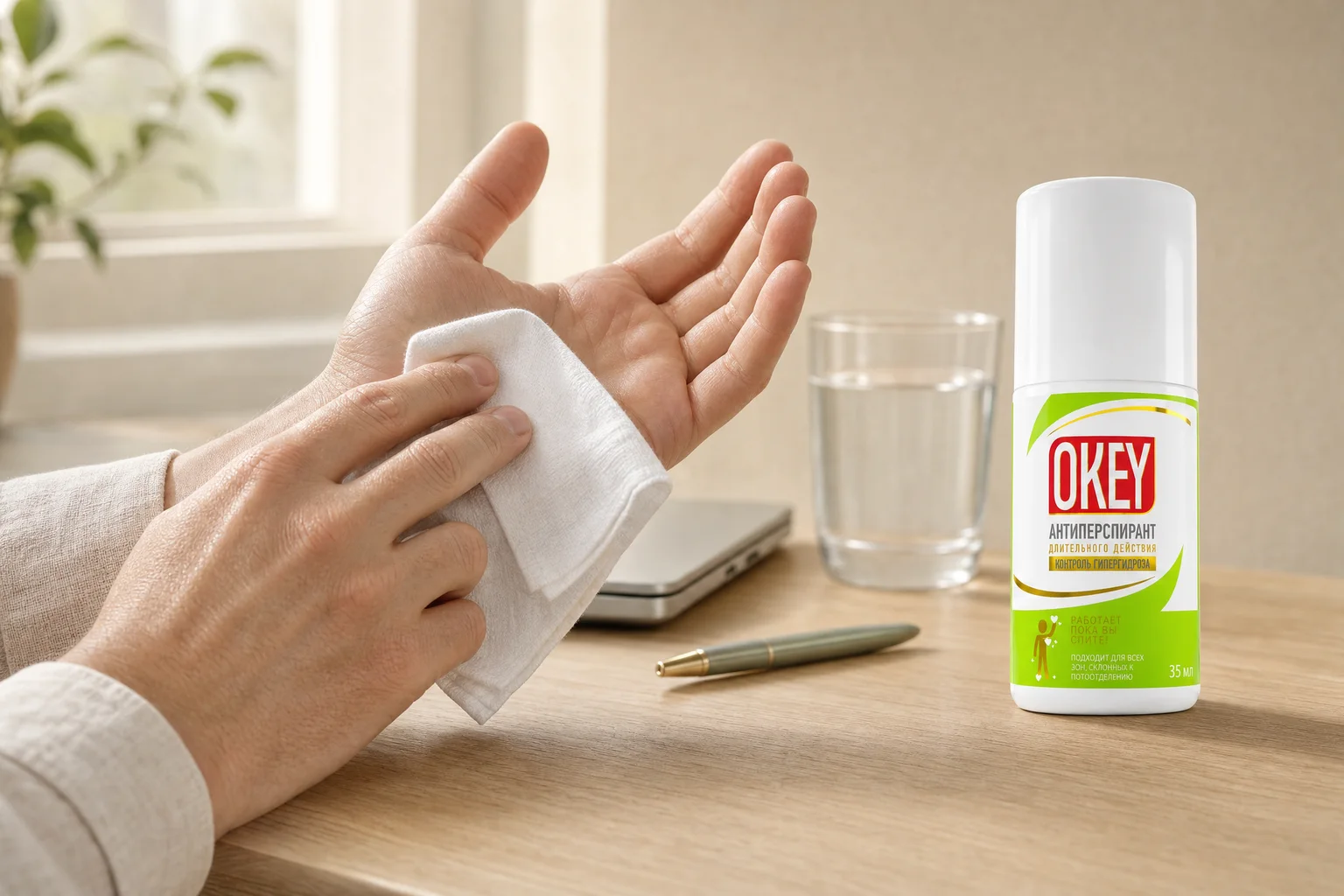
- before a handshake, discreetly wipe your palm on a tissue in your pocket;
- remember that other people notice your sweat far less often than you think: they are busy with themselves.
Telling the people close to you
Many people hide their sweating for years, even from a partner or parents. A short, honest conversation often removes half the tension: “I sweat a lot. It's just how my body works, not a hygiene problem. It's easier for me when I don't have to keep quiet about it.” If you are the parent of a teenager who is embarrassed about sweating, see “Teen sweating: how to talk to your child without awkwardness”: at that age teasing hurts most.
When to see a doctor or a therapist
Heavy sweating can be treated. Start with “The HDSS test: do I have hyperhidrosis?”, and read about treatment options, from antiperspirants to procedures, in “Hyperhidrosis: what treatment options are there?”. The NHS advises seeing a GP if body odour or sweat is affecting your self-esteem.
If fear of sweating or blushing makes you avoid meetings, conversations and journeys, it may be social anxiety. The NHS names cognitive behavioural therapy (CBT) as the best treatment; self-help based on its principles also helps, such as keeping a diary, breathing exercises and small steps towards situations that scare you. If you feel low all the time or have thoughts that you do not want to live, get help straight away, from a doctor or by calling 103 in Kazakhstan.
Bottom line: confidence starts with control
An antiperspirant does not treat embarrassment, but it can remove its most common trigger: wet underarms, palms or feet at the wrong moment. When sweat is under control, it is easier to raise your arms, shake hands and stop thinking about stains. OKEY is applied in the evening and washed off in the morning, so there is nothing to top up in the office bathroom during the day. If your sweating is very heavy, combine it with help from a doctor.
OKEY is a long-lasting, fragrance-free antiperspirant for women and men in a 35 ml roll-on bottle. It suits all areas prone to excessive sweating. According to the instructions, it is applied in the evening before bed in a thin layer to clean, completely dry and intact skin, and any residue is washed off in the morning. OKEY is available on Kaspi for 7990 ₸ with a 14-day bottle return. Regular customers can buy it on our website okeystaydry.com for 6990 ₸ with free delivery to a Flip pickup point, without a return option. The buy button is below.
Sources and documents
- International Hyperhidrosis Society: social embarrassment and psychological effects
- Bahar R. et al. The prevalence of anxiety and depression in patients with or without hyperhidrosis. Journal of the American Academy of Dermatology, 2016
- NHS: social anxiety, symptoms and treatment
- NHS: body odour, when to see a GP
- American Academy of Dermatology: hyperhidrosis treatment
- Full OKEY instructions