Sweating before a performance: how to prepare
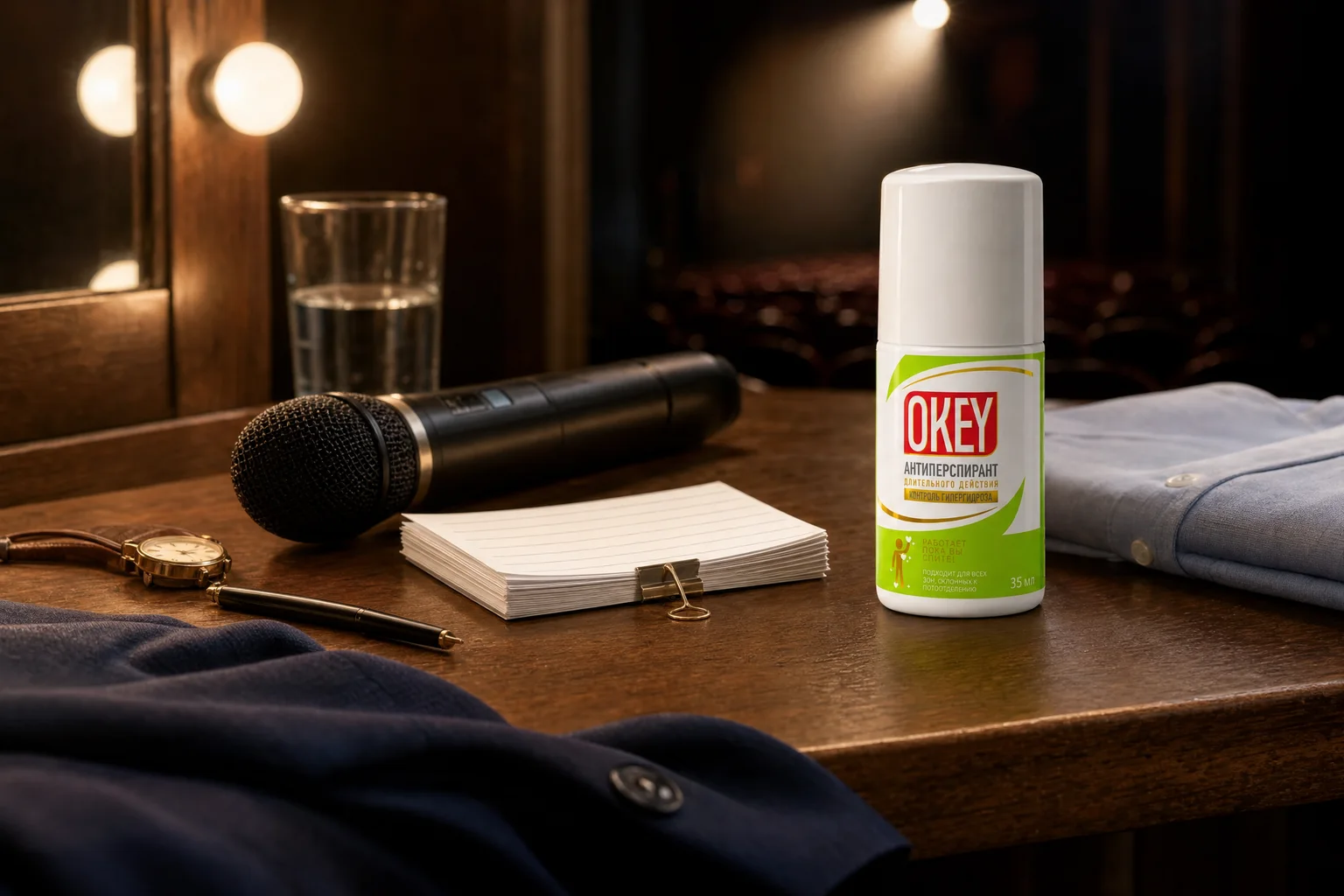
Stage lights, a jacket, a raised arm holding a microphone or pointer: on stage your underarms are more visible than anywhere else. We covered why nerves trigger sweating in a separate article. Here is a practical plan: what to do a week ahead, the evening before, in the morning and an hour before you go on.
Short answer
Nerves before a performance increase sweating, and the stage adds heat from the lights and close-fitting clothes. Rehearse in what you will wear, choose a loose top in breathable fabric and a layer that hides marks. Apply antiperspirant the evening before to completely dry skin. On the day, go easy on coffee, arrive early, bring water and a spare shirt, and breathe calmly before you go on.
Why sweat shows more on stage
We explained how nerves trigger sweating in “Sweating when nervous: why the body reacts to stress”. The AAD lists anxiety, nervousness and stress among common sweating triggers. Before a performance, the stage itself adds more.
- Spotlights and stage lighting, a stuffy hall, lots of people.
- A business suit or concert outfit that fits more closely than everyday clothes.
- Gestures: you raise your arms, point at the screen and hold a microphone, so your underarms are on show.
- Waiting: nerves build while you wait for your turn.
A week ahead: rehearse in your stage clothes
The best time to make decisions about clothes is during rehearsals, not on the morning of the performance.
- Do at least one rehearsal in what you will wear. Use the gestures you will use on stage and check in a mirror or on video where marks show.
- Choose a top that is loose around the underarms, in a breathable fabric: the NHS advises avoiding tight clothes and synthetics such as nylon. Damp marks usually show more on light, smooth, plain fabric than on patterned fabric or under a dark layer. More in “Which fabrics to choose if you sweat a lot: cotton, linen, wool and synthetics”.
- A jacket or blazer hides your shirt, but it is warmer under the lights. Decide in advance whether you will take it off.
- Shave or wax your underarms ahead of time: the OKEY instructions say to wait up to 48 hours after hair removal in the application area before using it.
- Note the situations in which you sweat more: the AAD recommends keeping a trigger diary like this. It will tell you what to prepare for next time.
The evening before
The evening before the performance is the key moment for preparing your underarms.
- Apply antiperspirant at bedtime to dry skin, as the AAD and the International Hyperhidrosis Society (IHHS) advise. If you have just showered, wait until your underarms are completely dry.
- Lay out your clothes, water and a spare shirt so you are not searching for anything in a rush in the morning.
- Say the opening of your talk out loud once more: a confident first few minutes take away some of the tension.
The morning and the last hour
On the day, the goal is not to add extra reasons to sweat.
- If you use OKEY, wash off the residue in the morning as the instructions say. After that you can apply your usual deodorant if you like.
- Go easy on coffee: the AAD names caffeine as one of the sweating triggers. More in “Coffee, spicy food and alcohol: what really makes you sweat more”.
- Arrive early so you do not have to rush: hurrying and a hot bus or car add sweat before you even reach the stage.
- Look around the hall: where you will stand, where to put your water, how hot it is under the lights.
- A few minutes before you go on, do the NHS breathing exercise: breathe in through your nose counting to five, and out through your mouth counting to five. The NHS suggests doing it for at least five minutes and practising it regularly, not only before going on stage.
If you sweat anyway
Even with good preparation, nerves sometimes win. That does not mean the performance has failed.
- Keep water and a tissue nearby to blot your forehead.
- Change into your spare shirt during a break: the AAD specifically advises carrying spare clothes so you can change into something dry if needed.
- Try not to keep adjusting your clothes or pressing your arms to your sides: open gestures look more confident, and paying extra attention to a mark only adds to the nerves.
When to see a specialist
If you sweat heavily not only before performances but also in calm situations, at night or every week, the NHS advises seeing a doctor: it may be hyperhidrosis. Treatment options are described in “Hyperhidrosis: what treatment options are there?”.
If your fear of performing is so strong that you turn down talks and stage appearances, that is also worth discussing with a doctor or psychologist. The AAD separately advises looking after your mental health, including through counselling and support groups.
The bottom line: go on stage prepared
Rehearsing in your real clothes, a loose cut, water, a spare shirt and calm breathing remove most of the risk. Your underarms are the part of the preparation that is easiest to take care of the evening before.
OKEY is made for this: a fragrance-free underarm antiperspirant for women and men, in a 35 ml roll-on bottle. Following the instructions, it is applied in a thin layer to completely dry skin in the evening before bed, and the residue is washed off in the morning, so on the day of your performance you do not need to think about reapplying. You can buy OKEY on Kaspi for 7990 ₸, with the option to return the bottle within 14 days. For regular customers it is 6990 ₸ on our site okeystaydry.com, with free delivery to a Flip pickup point and no returns. The buy button is below.