
Sweating in teenagers: how to talk to your child without awkwardness
The PE T-shirt smells different from a year ago, your child wears a hoodie even in the heat and no longer raises a hand in class. For many parents this is the first sign that puberty has started. It is a delicate subject: one careless word and a teenager shuts down. A calm conversation, on the other hand, helps them understand that their body is fine and find a solution.
Short answer
During puberty the sweat glands grow larger and more active, so teenagers sweat more and their sweat starts to smell. This is a normal part of growing up. Talk about it in private, calmly and without jokes, explain why it happens and suggest simple steps: a daily shower, skin dried thoroughly, clean clothes in breathable fabrics and a hygiene product of their own. Which product suits a teenager is best discussed with a paediatrician. See a doctor if signs of puberty appeared before the age of 8, if sweating gets in the way of school and friendships, or if it is sudden, happens at night or comes with other symptoms.
Why your teenager has started sweating more
Puberty usually starts between 8 and 14 in girls and between 9 and 14 in boys. At this stage, as NHS children’s services explain, the sweat glands get larger and the skin starts producing more oil. The glands in the armpits and groin respond not only to heat and sport, but also to nerves and stress.
Fresh sweat has almost no smell: odour appears when bacteria on the skin break it down. That is why puberty brings a new, more “grown-up” smell. There is more on this in “Why does sweat smell, and how can you get rid of the odour?”, and on sweating before a test or a performance in “Sweating when nervous: why the body reacts to stress”.
How to start the conversation
Teenagers are often embarrassed about sweat and hide it: they wear dark clothes, keep their arms pressed to their sides and avoid PE. The International Hyperhidrosis Society (IHHS) notes that heavy sweating in schoolchildren can lead to withdrawal, lower self-esteem and bullying. So it matters that a talk with a parent does not become one more source of shame.
- Pick a calm moment alone: in the car on the way home or over a cup of tea, not in front of siblings or friends.
- Start with growing up, not with a complaint. “Your body is changing right now, and sweat is a normal part of that” lands very differently from “you smell”.
- Do not joke about it, and do not discuss it with other adults in front of your child.
- Tell them what it was like for you at their age: it is easier for a teenager to know they are not the only one.
- Give them choices: which product, scented or unscented, where it will be kept. Teenagers stick more readily to decisions they made themselves.
- If the conversation does not go well, do not push. Come back to it in a few days or leave them a clear article to read.
Simple everyday steps
For body odour, the NHS advises washing the armpits regularly with soap and drying them thoroughly, wearing natural fabrics and changing clothes often. For a teenager it helps to turn this into a short list.
- A shower every day and after training, then dry the armpits thoroughly.
- A clean T-shirt and socks every day, and a spare T-shirt in the sports bag.
- Cotton and other breathable fabrics instead of dense synthetics. More in “Which fabrics to choose if you sweat a lot: cotton, linen, wool and synthetics”.
- Wash sports kit straight away rather than leaving it in the bag until the next session. How to freshen it up is covered in “How to get the sweat smell out of sportswear”.
Deodorant or antiperspirant
A deodorant deals with odour; an antiperspirant reduces the amount of sweat. If smell is the only concern, washing and a deodorant are often enough. If damp patches remain despite good hygiene, the NHS mentions stronger antiperspirants as one of the first steps for excessive sweating.
But adult products do not always suit teenagers: strong antiperspirants can have restrictions and can irritate the skin. So it is best to discuss a product for your child with a paediatrician or dermatologist and read the instructions together. If burning or itching appears after applying it, the product should be washed off; see “Irritation, itching or burning from antiperspirant: causes and what to do”.
When to take your teenager to a doctor
The NHS advises seeing a doctor if signs of puberty appear before the age of 8: it is usually nothing to worry about, but the cause is worth checking. Also book an appointment if:
- sweating gets in the way of school, sport or friendships, and simple measures do not help;
- the palms, feet or face sweat heavily even when it is not hot and your child is not nervous;
- the sweating started suddenly, happens at night or comes with fever, weight loss or a racing heart;
- the smell has changed sharply for no obvious reason.
The bottom line: what a family can do
The most important thing a parent offers is a calm tone and the reassurance that the body is fine. Hygiene, comfortable clothes and a product chosen with a doctor solve most of the questions, and if sweating is affecting daily life, a dermatologist can help.
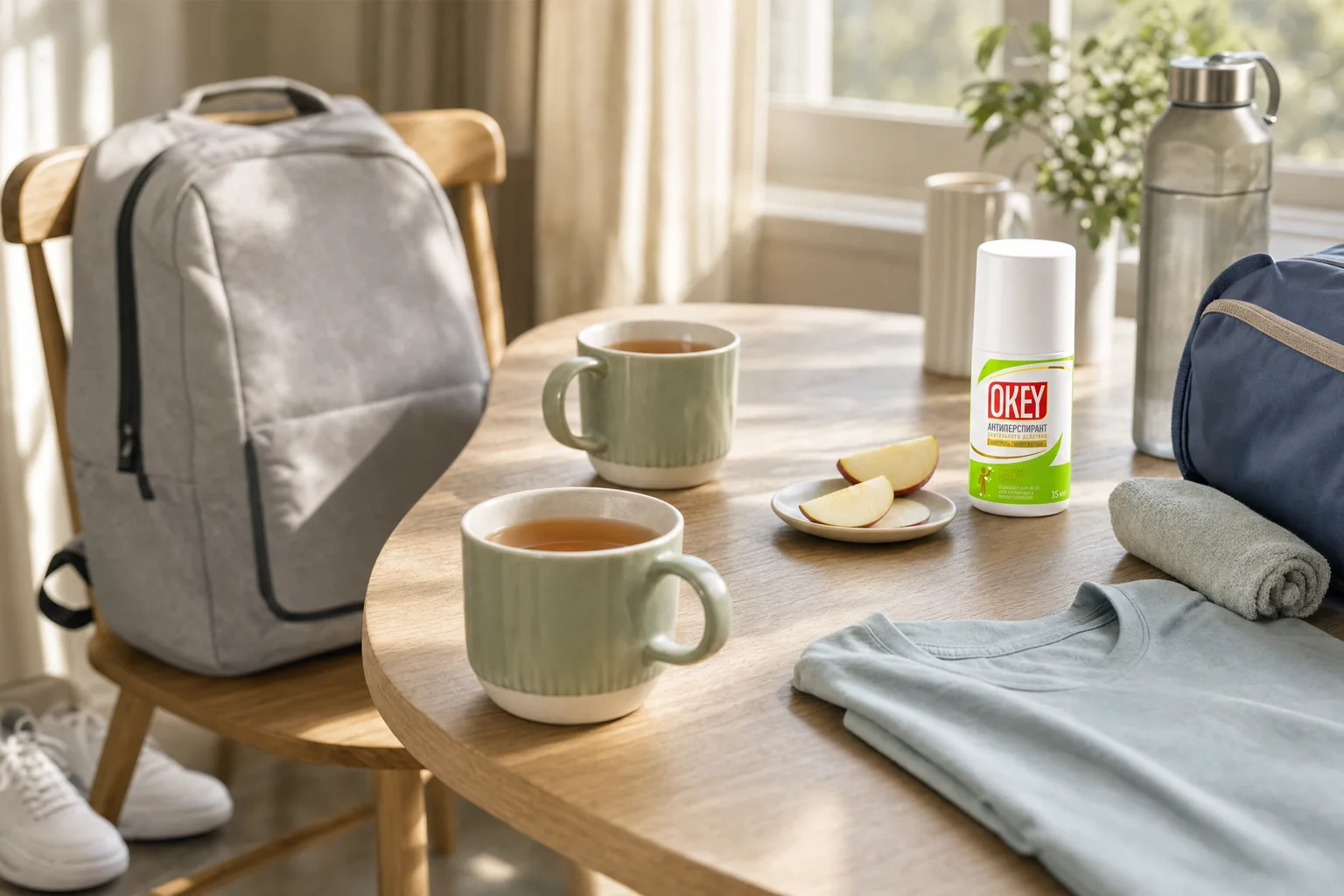
OKEY is an underarm antiperspirant for adults, women and men: fragrance-free, in a 35 ml roll-on bottle. We do not offer it as a product for children or teenagers: if you would like to try OKEY for a teenager, talk to a doctor first. Adults in the family use it as the instructions say: a thin layer on completely dry skin in the evening before bed, with the residue washed off in the morning. On Kaspi OKEY costs 7990 ₸, and the bottle can be returned within 14 days. For regular customers it is 6990 ₸ on our site okeystaydry.com, with free delivery to a Flip pickup point and no returns. You can buy it using the button below.
Sources and documents
- NHS (Cambridgeshire and Peterborough children’s services): hygiene for young people and teenagers
- NHS: body odour
- NHS: early or delayed puberty
- NHS: excessive sweating (hyperhidrosis)
- American Academy of Dermatology: hyperhidrosis causes
- International Hyperhidrosis Society: school nurses and early help for children
- Full OKEY instructions