Sweat and makeup: how to keep your makeup on when you sweat
The short answer: clean, dry skin, light oil-free products, thin layers, blotting instead of wiping and as little overheating as possible. Makeup cannot stop your face from sweating, but it can stay on longer and be easy to touch up. Below is a step-by-step routine and an honest look at where cosmetics stop helping.
Short answer
Wash your face and let your skin dry completely. Choose products labelled “oil free” and “noncomedogenic”, oil-free water-based makeup and matte products: that is what the American Academy of Dermatology (AAD) advises for oily skin. Do not wipe sweat away; blot it with blotting papers. Use a water-resistant sunscreen and reapply it after sweating (AAD). If your face gets wet even when you are cool and resting, it may be facial hyperhidrosis, which a dermatologist treats. Body antiperspirant, OKEY included, is not something to put on your face on your own.
Why makeup slides off
Sweat is almost entirely water: according to Cleveland Clinic, sweat from the eccrine glands is about 99% water, and most of the rest is salt. On the face it mixes with skin oil and softens foundation and powder, so the product gathers in creases, runs down the temples and the nose turns shiny. The oilier the skin and the more layers, the sooner it shows.
Everyone's face sweats in the heat, during exercise, when nervous and after hot drinks. But Cleveland Clinic lists the face among the areas affected by primary hyperhidrosis, together with the underarms, hands and feet; it usually starts before age 25. If your forehead and upper lip get wet even when it is cool, makeup is not the issue; more on that near the end.
Preparing your skin
For oily skin, the AAD advises washing your face up to twice a day and after sweating, and choosing skin care products labelled “oil free” and “noncomedogenic” (they do not clog pores). This matters most before makeup: foundation sits better on clean skin than on a layer of sweat and cream.
- wash with a gentle cleanser and pat your face dry with a towel without rubbing;
- wait until your skin is completely dry and cool: after a shower or coming in from outside, give it a few minutes in a cool room;
- moisturiser should be light and oil-free; let it absorb before the next layer;
- sunscreen should be water resistant with SPF 30 or higher: the AAD advises applying it before going out, because skin needs about 15 minutes, and reapplying immediately after sweating.
Primer, foundation and setting spray
Primer and setting spray do not reduce sweating. They are cosmetics that help makeup stay put, and the result depends on the specific formula: we found no reliable research on which primers hold up best to sweat. The AAD gives clear pointers instead: for oily skin, choose oil-free, water-based makeup, and products labelled “matte” can help reduce shine.
- primer goes on in a thin layer on the forehead, nose and chin, where sweat and shine appear first;
- foundation should be light, oil-free and thin: the fewer layers, the less there is to slide;
- powder goes on lightly, on the same areas;
- setting spray comes last if it suits you; if it stings or you break out, stop using it;
- waterproof mascara and eyeliner smudge less if sweat runs down from your forehead.
Blot, do not wipe
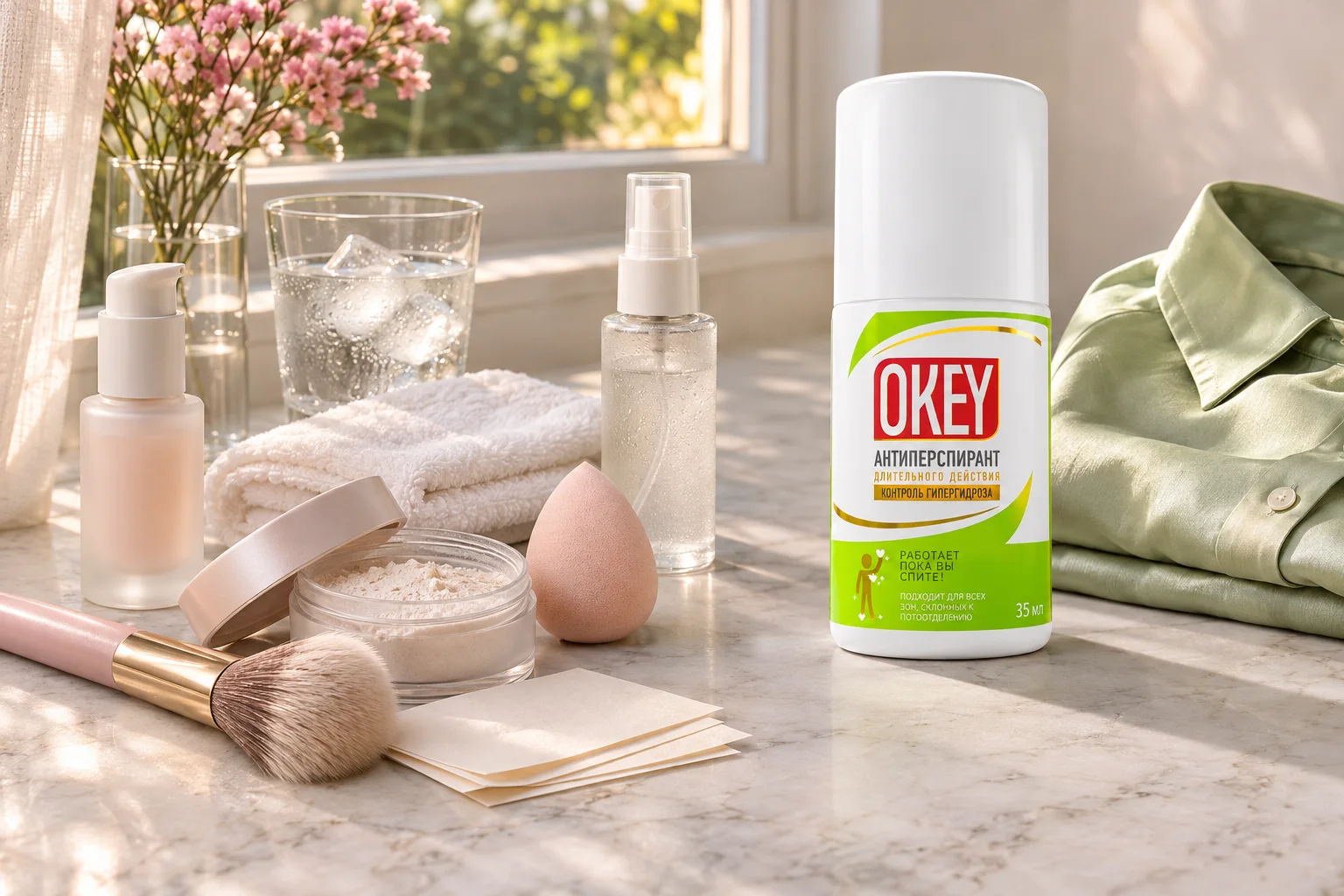
The AAD advises using blotting papers throughout the day. Press a sheet against your skin for a couple of seconds and lift it off: it takes up sweat and oil without moving your foundation. Wiping your face with your palm or a handkerchief takes the makeup off in a streak. Touching up over damp skin does not work: blot first, then add a little powder. What to keep in your bag:
- blotting papers or a folded clean paper tissue;
- pressed powder;
- a small cotton towel or handkerchief for the neck and hairline;
- water: in hot weather the NHS advises drinking extra fluids.
Less sweat on the face: staying cool and avoiding triggers
The best setting spray is less overheating. In hot weather the NHS advises staying in the shade, especially between 11am and 3pm, wearing light clothes and a hat, drinking extra fluids, avoiding activity that makes you hotter, and avoiding alcohol, caffeine and hot drinks.
- do your makeup in a cool room and go out once your skin has cooled down;
- cool the car down in advance; more in “Sweating in the car and on public transport: how to arrive dry”;
- at a celebration, keep blotting papers and water close; a plan for the whole day is in “Sweating at a wedding or celebration: how to get through the day”;
- if your face sweats when you are nervous, the preparation in “Sweating before a performance: how to prepare” can help.
Antiperspirant on the face: why we do not recommend it
It is tempting to put on your forehead what you use on your underarms. But the IHHS warns that strong antiperspirants can irritate the skin of the face and head. They must be kept out of the eyes, applied only to completely dry skin, a new product is tried on a small area first, and the routine is agreed with a doctor.
The OKEY instructions say to avoid contact with the eyes and mucous membranes and do not describe applying it to the face. So we do not recommend OKEY for the face: that is a question for a dermatologist.
When to see a dermatologist
If your forehead, scalp and upper lip get wet even when you are resting and cool, and no trick keeps your makeup on, it may be craniofacial hyperhidrosis, excessive sweating of the face and head. The IHHS writes that it is treated with antiperspirants, botulinum toxin injections, tablets and topical medicines, often in combination, and that these should be chosen with a doctor.
Cleveland Clinic advises seeing a provider if sweating affects your life, makes you avoid people or activities or gets worse over time, and also if you sweat in your sleep. If sweating comes with chest pain, nausea or dizziness, get help right away. An overview of treatments is in “Hyperhidrosis: what treatment options are there?”.
Bottom line: the face is for cosmetics and the doctor, the body is for antiperspirant
For the face, skin preparation, light oil-free products, blotting and staying cool are what work. For the body, an antiperspirant. With dry underarms it is easier to wear a light blouse or dress, raise your arms in photos and think less about marks.
OKEY is applied in the evening to dry skin of the underarms or other body areas prone to sweating, and any residue is washed off in the morning, before makeup. We do not recommend it for the face.
OKEY is a long-lasting, fragrance-free antiperspirant for women and men in a 35 ml roll-on bottle. It suits all areas prone to excessive sweating. According to the instructions, it is applied in the evening before bed in a thin layer to clean, completely dry and intact skin, and any residue is washed off in the morning. OKEY is available on Kaspi for 7990 ₸ with a 14-day bottle return. Regular customers can buy it on our website okeystaydry.com for 6990 ₸ with free delivery to a Flip pickup point, without a return option. The buy button is below.
Sources and documents
- American Academy of Dermatology: oily skin, cleansing, blotting papers, oil-free makeup
- American Academy of Dermatology: how to apply sunscreen
- Cleveland Clinic: what sweat is made of
- Cleveland Clinic: hyperhidrosis, affected areas, onset and when to see a provider
- International Hyperhidrosis Society: sweaty face and head, treatment and caution with antiperspirants
- International Hyperhidrosis Society: what to do about excessive face and scalp sweating
- NHS: how to cope in hot weather
- Full OKEY instructions