Sweating in the car and on public transport: how to arrive dry
You get into a hot car and five minutes later your back is wet. You stand on a packed bus in your coat, afraid to raise your arm to the handrail. Travelling is one of the most common situations where sweat catches people off guard. Here is what helps before, during and after the journey.
Short answer
A car in the sun heats up very quickly: in a Stanford University study, the temperature inside rose by an average of 22 °C within an hour, with 80% of the rise in the first half hour; a cracked window made almost no difference. Before driving, air the car out, use a sunshade and a breathable seat cover, and dress in layers. On the bus, take off your outer layer before you get hot. Cold sweats and pallor on a journey can come from motion sickness: the NHS advises looking into the distance and letting in fresh air. Never leave children or animals in a car.
Why you sweat more on the road
In a car, your back and thighs are pressed against the seat and sweat there hardly evaporates. In summer add a hot interior, in winter a warm coat and the heater on full. On buses and the metro there are crowds, stuffy air and having to hold a handrail with your arm raised. Add rushing and traffic jams, and sweat from nerves piles on top of sweat from heat.
A parked car: cool it before you get in
Stanford University researchers (McLaren, Null, Quinn, Pediatrics, 2005) measured the temperature in a car parked in the sun. Within an hour, the interior heated up by an average of 22 °C regardless of the weather outside, and 80% of that rise happened in the first 30 minutes. A cracked window had almost no effect on how fast it heated up or on the final temperature.
So before you drive:
- park in the shade or use a reflective sunshade on the windscreen;
- open the doors for a minute before getting in to let the hot air out;
- switch on the air conditioning and drive the first few minutes with the windows slightly open, then close them;
- never leave children or animals in the car, even for a few minutes.
What to wear and what to keep in the car
What helps in the car:
- a light, breathable seat cover or a mesh back pad;
- layers: take off your coat or jacket before getting behind the wheel, not at the traffic lights;
- a light-coloured cotton or linen shirt or t-shirt, more in “Fabrics for heavy sweating”;
- a bottle of water and a spare t-shirt in the boot for long trips;
- a tissue or small towel for your palms.
Wet palms on the steering wheel
Sweaty palms on the wheel are not just uncomfortable but a safety issue: your hand can slip. Keep a small towel in the car and use driving gloves if needed. If your palms are always wet, not only in the heat, read “Sweaty palms: what to do”: it may be palmar hyperhidrosis, and it can be managed.
If you get very nervous behind the wheel, after an accident, on a new route or with an examiner, stress makes sweating worse. How to break that cycle is covered in “Sweating when nervous: why the body reacts to stress”.
Buses, the metro and trains
The main rule on public transport is to take off your outer layer before you get hot. In winter, unzip your coat and take off your scarf as soon as you get on. If you can, stand near the doors or a window, where there is more air.
Cold sweats, pallor, nausea and dizziness on a journey can be signs of motion sickness. The NHS advises sitting at the front (in a car, in the front seat), looking at a fixed point in the distance, letting in fresh air, closing your eyes and breathing slowly, and taking breaks on long journeys.
If the heat makes you unwell on the way
Heavy sweating with dizziness, headache, nausea and intense thirst in a hot car or carriage are signs of heat exhaustion. The NHS advises moving somewhere cool, removing extra clothing, drinking water and cooling the skin. If the person is not better within 30 minutes, or has hot dry skin, confusion or a seizure, call 103 or 112 in Kazakhstan.
Bottom line: prepare in the evening, not in the car park
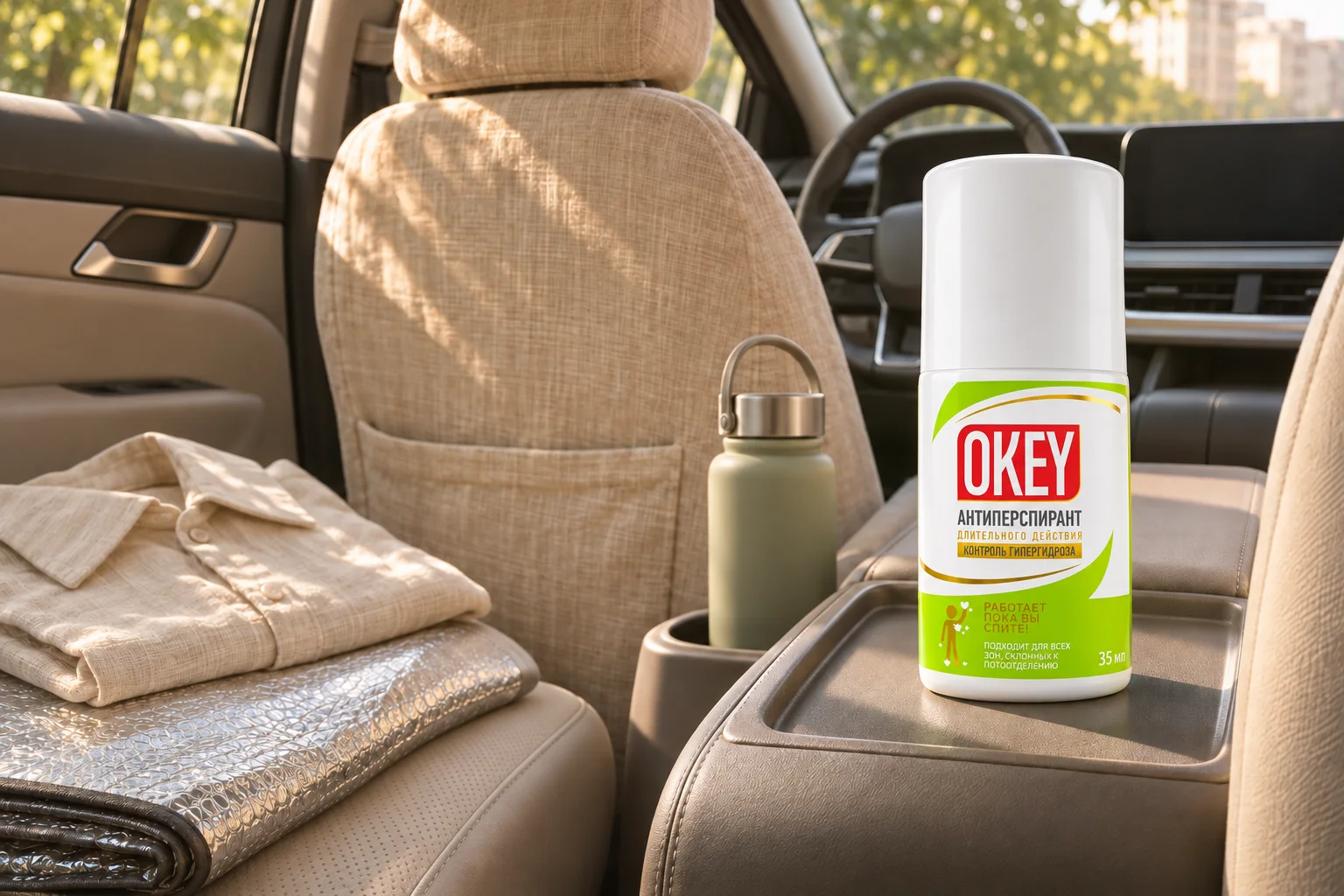
On the road there is no shower and not always a chance to change, so what you did the day before matters most. OKEY is applied in the evening before bed to dry skin and washed off in the morning, and the effect lasts through the day: in the car, on the bus and on a long journey. It suits all areas prone to excessive sweating, including the palms.
OKEY is a long-lasting, fragrance-free antiperspirant for women and men in a 35 ml roll-on bottle. It suits all areas prone to excessive sweating. According to the instructions, it is applied in the evening before bed in a thin layer to clean, completely dry and intact skin, and any residue is washed off in the morning. OKEY is available on Kaspi for 7990 ₸ with a 14-day bottle return. Regular customers can buy it on our website okeystaydry.com for 6990 ₸ with free delivery to a Flip pickup point, without a return option. The buy button is below.