Why sweating differs between men and women
“Men sweat more and women smell less” is a common belief. Science gives a more careful answer: everyone has the same sweat glands, and most of the difference comes down to body size, workload, hormones and skin bacteria. Here is what really differs and what is a myth.
Short answer
Men and women have sweat glands of the same structure. During exercise men produce more sweat on average, mainly because they are larger and generate more heat; studies by Gagnon and Kenny showed that at moderate workloads the difference almost disappears, while at high heat loads women produce less sweat per gland. In women, sweating is influenced by the menstrual cycle, pregnancy and menopause. Underarm odour also differs slightly in composition. Heavy sweating affects everyone, and the products for it are not split into men's and women's.
The same glands
Men and women have the same sweat glands. Eccrine glands are found almost all over the body and cool it down; apocrine glands sit in the underarms and groin and switch on at puberty, which, as Cleveland Clinic explains, is why young children have no body odour.
So the question is not whose glands are different, but how much heat the body produces, how hormones affect the glands and which bacteria live on the skin.
Who sweats more during exercise
If a man and a woman run at the same speed, the man usually produces more sweat. Canadian physiologists Gagnon and Kenny looked at where this difference comes from. Most of it is explained not by sex but by body size and how much heat the body generates during exercise: a larger, heavier person has more heat to get rid of.
When the researchers matched the heat load, there was almost no difference between men and women at moderate work. It appeared only above a certain threshold: at high heat loads, each sweat gland in women produced less sweat, while the number of active glands was similar.
- less sweat in a woman during exercise does not mean she cools down worse in everyday life;
- sweat on a t-shirt depends more on weight, fitness, heat and clothing than on sex;
- two people of the same sex can sweat very differently.
Hormones and the cycle
In women, sex hormones have a noticeable effect on sweating. A review by Japanese physiologist Nagashima (Temperature, 2015) describes how in the second half of the cycle, after ovulation, body temperature is higher and sweating starts at a higher temperature than in the first half.
Hormones show their effect most strongly during pregnancy and menopause, covered in “Sweating during pregnancy” and “Sweating during menopause”. Men can get similar hot flushes with sweating when testosterone falls, for example during hormone therapy for prostate cancer. More in “Sweating and hormones”.
Odour differs too
Fresh sweat hardly smells: odour appears when skin bacteria break down substances from the apocrine glands. In a study by Troccaz and colleagues (Chemical Senses, 2009), women's underarm sweat contained relatively more of a sulphur-containing odour precursor, while men's contained more of a precursor of a sour, cheesy smell. So it is the character of the odour that differs rather than its strength.
Cleveland Clinic notes that men have body odour problems more often and links this to thicker underarm hair. How odour works and what helps is covered in “Why does sweat smell, and how can you get rid of the odour?”.
Heavy sweating affects everyone
Hyperhidrosis, sweating far beyond what the body needs to cool down, affects both men and women. It has nothing to do with how manly or well-groomed someone is, and it is nothing to be ashamed of. If sweat gets in the way of work, social life or sleep, start with the self-test “The HDSS test: do I have hyperhidrosis?” and the article “What is hyperhidrosis, and when should you see a doctor?”.
See a doctor if sweating has started suddenly, comes at night, or comes with weight loss or fever: the NHS treats this as a reason to get checked.
Bottom line: one product for both
The differences between the sexes are real but small, and they do not call for a men's or a women's antiperspirant. What matters more is how much and where you sweat and how sensitive your skin is. We compared products in detail in “Antiperspirant for men and women: is there a difference?”.
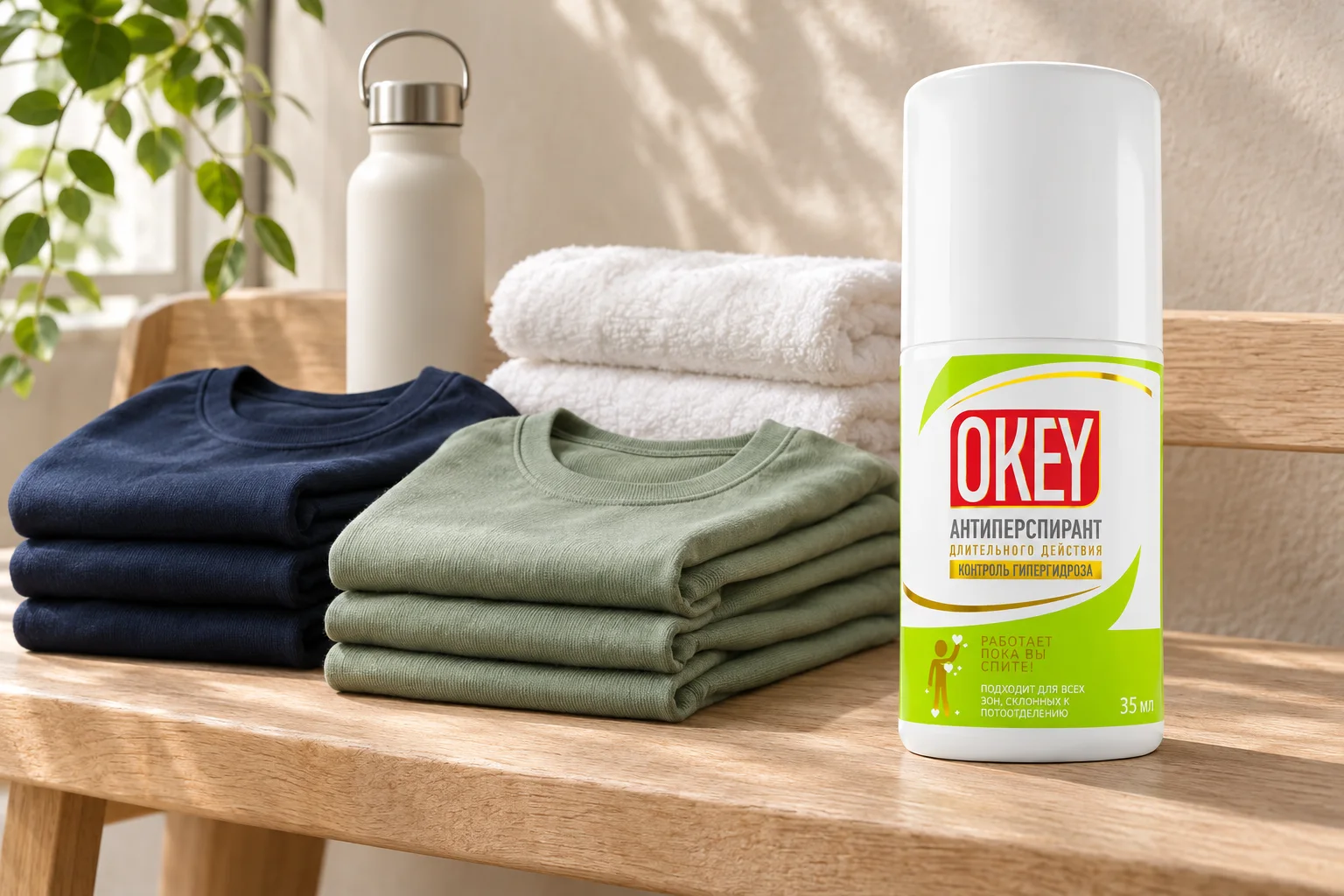
OKEY is a long-lasting, fragrance-free antiperspirant for women and men in a 35 ml roll-on bottle. It suits all areas prone to excessive sweating. According to the instructions, it is applied in the evening before bed in a thin layer to clean, completely dry and intact skin, and any residue is washed off in the morning. OKEY is available on Kaspi for 7990 ₸ with a 14-day bottle return. Regular customers can buy it on our website okeystaydry.com for 6990 ₸ with free delivery to a Flip pickup point, without a return option. The buy button is below.
Sources and documents
- Gagnon D., Kenny G. P. Sex differences in thermoeffector responses during exercise at fixed requirements for heat loss. Journal of Applied Physiology, 2012
- Gagnon D., Kenny G. P. Does sex have an independent effect on thermoeffector responses during exercise in the heat? Journal of Physiology, 2012
- Nagashima K. Thermoregulation and menstrual cycle. Temperature, 2015
- Troccaz M. et al. Gender-specific differences in axillary odour precursors. Chemical Senses, 2009
- Cleveland Clinic: body odour, causes and glands
- NHS: excessive sweating (hyperhidrosis)
- NHS: night sweats, when to see a GP
- Full OKEY instructions